
 Български

How to Choose a Protective Net for a Sports Facility
Protective nets are an important part of the equipment used in sports halls, playing fields and training facilities. They help prevent balls from leaving the playing area, protect spectators, windows, lighting fixtures and other elements of the building, and allow different sporting activities to take place safely in close proximity to one another.
Choosing the right net, however, involves more than simply determining its dimensions. The type of sport, mesh size, material, twine thickness, fixing method and operating conditions all have a direct impact on its effectiveness and service life.
1. Determine the Purpose of the Net
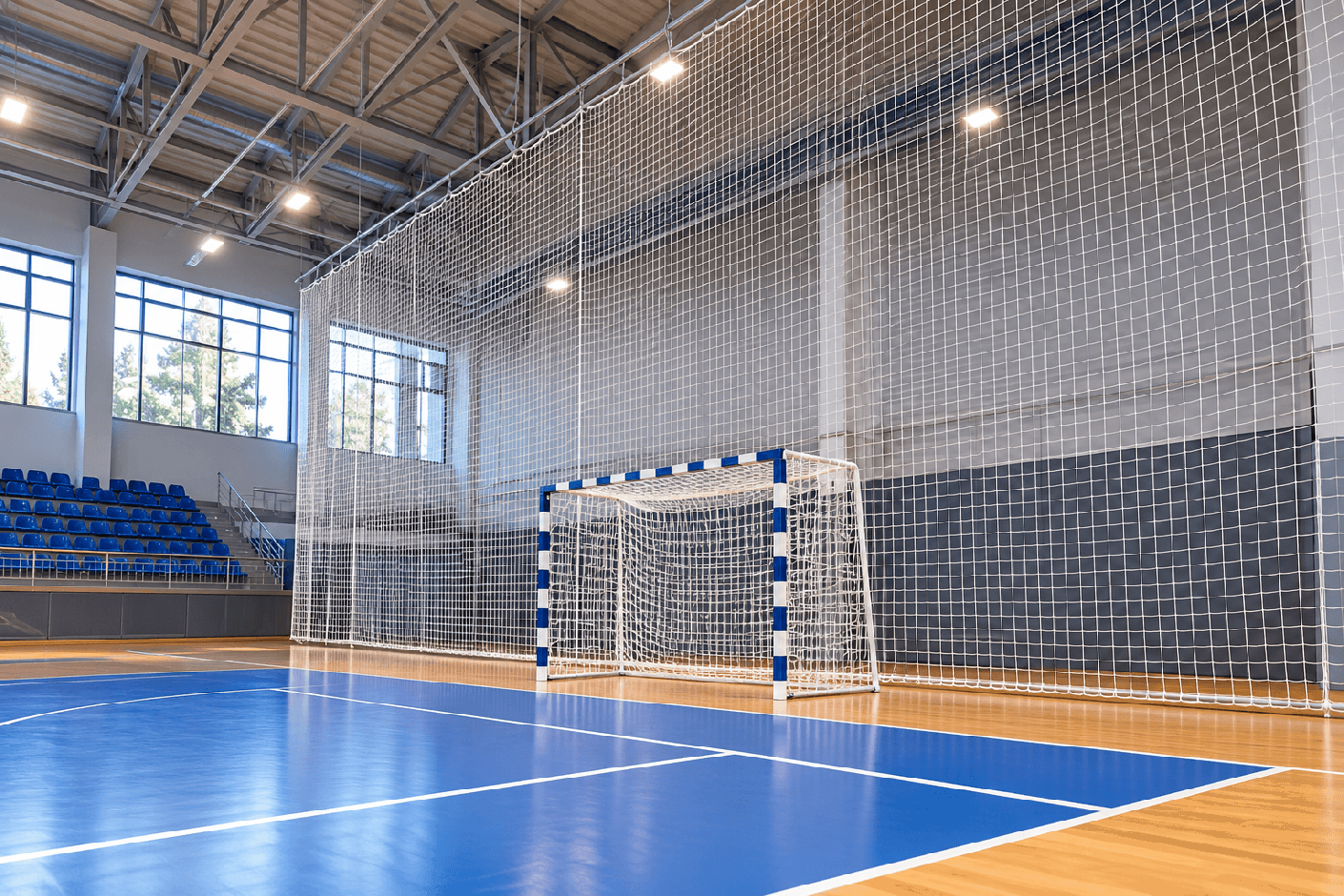
The first step is to determine the function the net needs to perform. In a sports hall, it may be installed behind football or handball goals, around the playing area, as a divider between separate training areas, or to protect windows, walls and equipment.
At outdoor sports facilities, protective nets are often used around the perimeter to prevent balls from leaving the playing area. In such applications, environmental conditions must also be taken into account, including prolonged exposure to sunlight, moisture, temperature changes and wind.
2. Choose the Appropriate Mesh Size
The mesh size should primarily be selected according to the type and size of the ball used in the relevant sport. A net designed for football or handball may not necessarily be suitable for sports involving significantly smaller balls.
A smaller mesh provides better containment of smaller sports balls, but it also increases the amount of material, the weight of the net and its wind resistance. The mesh size should therefore be selected according to the specific application rather than on the assumption that a smaller mesh is always better.
3. Consider the Material and Twine Thickness
The material and construction of the net largely determine its strength, weight and durability during long-term use. In sports facilities, nets are exposed to repeated ball impacts, tension and mechanical loads, while outdoor installations must also withstand environmental conditions.
The thickness of the twine should also correspond to the expected load. Areas where the net regularly absorbs powerful ball impacts require a stronger construction than applications where the net is used simply to divide different areas of a sports hall.
4. Plan the Suspension and Fixing System
Even a high-quality protective net will not perform correctly if it is installed improperly. A reliable supporting structure and an even distribution of loads around the perimeter of the net are essential.
The net should be neither excessively loose nor unnecessarily tight. An appropriate suspension system allows it to absorb the energy of a ball impact without placing excessive stress on the net itself or on its fixing points.
5. Match the Dimensions to the Facility
Before ordering a net, the exact dimensions of the area to be protected should be determined. In more complex sports facilities, structural elements such as columns, beams, lighting fixtures, doors and windows should also be taken into consideration.
Planning the dimensions and installation method in advance reduces the need for later adjustments and allows the protective net to be integrated more effectively into the sports facility.
6. Do Not Neglect Regular Inspection
Protective nets are subject to wear and should be inspected periodically. Particular attention should be paid to fixing points, areas exposed to frequent ball impacts and sections subjected to greater mechanical or environmental stress.
Damaged twine, deformed fixing components or significant sagging are indications that maintenance, repair or replacement may be required.
Conclusion
A properly selected protective net should correspond to the type of sport, the size of the balls being used, the operating conditions and the structure of the particular facility. Mesh size, twine strength and installation quality are interconnected factors and should be considered as parts of a complete system.
NENOV SPORT provides protective nets for sports halls, playing fields and other sports facilities, selected according to the specific application and dimensions of each facility.